
Live Dealer Casinos Etiquette
Playing on a live online casino platform is the ultimate option for all who want to escape the dressing-up and going-to-a-social-place part when the urge for some wagers arises. It’s fast, stress-free, and takes you to a real land-based casino in zero time and with zero efforts. But if you somehow think that your computer screen is an anonymity-providing shield covering your bad manners, you’re totally wrong. Good behaviour is always a necessity. Find out which are the formal and informal rules when playing with a live dealer in the paragraphs below.
Just as in land-based casinos, the live online tables usually welcome more than just one player. This means that there is a limit of how many people can play at the same time. With that in mind, it is not recommended to take a seat for the sole purpose of watching. Your observing position may deprive someone else who really wants to participate in the game of doing exactly so.
Meanwhile, landing a table spot with the intention to play requires some off-the-table preparation. Again, you won’t be playing alone, there are other players on the table as well as a dealer who is trying to do their job. So, the number one requirement for joining a table is knowing the game, its rules, payouts, and additional terms and conditions. Getting to know a game from scratch on a live table is not a good idea. It will take you too long to do whatsoever and you will feel confused which can lead to wrong and inadequate decisions.
Speaking of decisions, most live players have experience in the dynamic live stream casino environment and tend to make pretty fast decisions. When you don’t know the game’s basics each move will take you forever. And slowing down the game is not acceptable. Moreover, because of time pressure, going for the optimal action may be hindered or even blocked. You’ll have not more than a few seconds to consider the given situation and then to act. What I suggest is finding a similar RNG casino game with a demo mode and using it for practice purposes instead of directly joining a live stream gameplay. Only when you feel confident enough, make the switch to your preferred live dealer table.
What’s also very important is treating the other players and the dealer with respect. A losing streak is not a reason to insult any of the other participants. Most live dealer tables come with a live chat where your manners are most needed. Online casinos have strict policies about strong language and disrespectful behaviour and not being polite is the fastest way to get banned from any platform.
In the end, I think that playing live is the closest you can get to the perfect casino experience. You have the comfort and the realistic feel all at once. However, understanding the necessary etiquette is just part of the rules and the authentic casino ambiance. Without it, it will all just be nothing but the next RNG game. Check out the best live dealer casinos reviewed and join the live player’s crew, just take your manners along and you’ll be good to go.
Read More → Playing live casino games is super exciting and has been my preferred way of gambling for the last few years. It’s the closest you can get to a land-based casino feel without having to give up the comfort of your own home. I know from my own experience that it can also be super intimidating especially for first-time players or for someone who is used to RNG- based games. So, to the rescue, here I am! These will be my simple tips on playing with a live dealer and I hope to prove that it’s nothing to be afraid of!
  Before joining any live dealer table, I would suggest loading your cash balance as much as you can afford. Live games have typically higher bet limits as they are very popular among high rollers. Be prepared by researching the different table limits before entering the live stream, so that you don’t land on a table which you can’t afford. If you have already done that, my next tip would also come in handy.
  What really annoys me is when people say that the main goal in blackjack is to get your hand’s total as close to 21 as possible. Although it’s partially true, it’s absolutely misleading. The object is to beat the dealer and you have only two options to do that – to end up with a higher total than them or to let them bust before you do. If you always chase the closer-to-21-result, your bankroll will go missing with the speed of light.
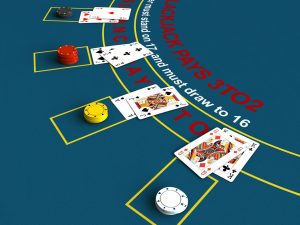 Number one is to choose your preferred blackjack variation wisely. This means to find the most favourable rules. The ideal situation would feature a 3:2 blackjack payout, the dealer standing on 17 and the player being allowed to spilt aces and to double afterward. The number of decks is just as important – less is always better but keep in mind that casinos often try to trick the not so experienced players by concealing a set of unfavourable rules with a lower card decks number.
My second tip is to not give in to any insurance or side bets! These are some of the worst casino odds you can get! And I admit, they sound so tempting but are rarely a good idea. Their only purpose is to earn the casinos more money and even if you get lucky once in a while, side bets could turn into a bankroll disaster in the long run.
The last thing I’d like to point out is something you’ve probably heard a million times before, yet somehow many players still skip the strategy chart. It’s your ideal adviser and a free cheat sheet, so please, don’t waste it!
Number one is to choose your preferred blackjack variation wisely. This means to find the most favourable rules. The ideal situation would feature a 3:2 blackjack payout, the dealer standing on 17 and the player being allowed to spilt aces and to double afterward. The number of decks is just as important – less is always better but keep in mind that casinos often try to trick the not so experienced players by concealing a set of unfavourable rules with a lower card decks number.
My second tip is to not give in to any insurance or side bets! These are some of the worst casino odds you can get! And I admit, they sound so tempting but are rarely a good idea. Their only purpose is to earn the casinos more money and even if you get lucky once in a while, side bets could turn into a bankroll disaster in the long run.
The last thing I’d like to point out is something you’ve probably heard a million times before, yet somehow many players still skip the strategy chart. It’s your ideal adviser and a free cheat sheet, so please, don’t waste it! I’ve lived and worked in London for almost a decade now, desperately pursuing a career in the fashion industry. I’ve always loved to sketch my own models and to create all sorts of unique clothing pieces. My online boutique has not so many clients, however, they are all super loyal. Just as I am. That completes the short summary of my creative nature.